
Your AI investments are probably underperforming because organisational readiness, rather than tooling, determines how much value can actually be extracted. Realising the ROI of AI investments reminds us of the importance of change management and of the need of institutionalising novel capabilities. Let’s look into this closely.
Focus On: The Organisational Readiness Crisis Behind Enterprise AI
Senior executives have largely approached generative AI as a tooling decision: procure a platform, deploy licences, run training, and measure engagement. The underlying assumption is linearity—availability drives adoption, adoption drives productivity, productivity drives value. The data emerging from various 2025 surveys decisively breaks that assumption.
Across large-scale enterprise deployments, frontier workers send materially more AI messages than median workers, often several multiples more. Frontier firms also generate far higher volumes of messages to standardised workflow agents (custom GPTs and equivalent), signalling a shift from individual experimentation to institutionalised practice. At the same time, a persistent minority of monthly active users never access advanced features such as data analysis, reasoning models, or workflow integrations. This is not a model limitation. It is a behavioural and operating-model issue.
A second pattern is even more interesting. Only a minority of organisations scale beyond pilots. The rest accumulate proofs of concept like case law without precedent—interesting, locally persuasive, but lacking the authority to generalise. The outcome is predictable: leadership claims progress, while the business sees little sustained impact.
The value gap is driven by readiness—how systematically the organisation has redesigned workflows, incentives, governance, and measurement to make AI usable at scale. Identical tools produce radically different outcomes.
The scaffolding problem: why pilots stall
Most AI initiatives fail for the same reason many transformation programmes fail: they confuse adoption with institutionalisation. In legal terms, a pilot is merely evidence. It does not establish doctrine. Frontier firms treat AI as organisational infrastructure; median firms treat it as a feature.
Infrastructure, in this context, has a precise meaning. AI is designed into workflows rather than bolted onto them. Teams do not simply learn how to use a tool; they learn how decisions should be made differently because the tool exists. Governance is not a brake applied ex post, but a framework designed ex ante so execution can accelerate within clear boundaries. A fortiori, leaders accept that productivity gains without workflow redesign will be temporary, and that measurement anchored in “usage” will mislead.
This is where most organisations are structurally exposed. They deploy AI into systems built for human-only work: fragmented processes, undocumented knowledge flows, inconsistent data access, unclear decision rights, and incentives misaligned with experimentation. In such an environment, AI can only deliver incremental benefits—typically captured by a small cohort of motivated power users—while the organisation itself remains unchanged.
Frontier firms invert the sequence. They design the operating model first and then instrument AI into it. The result is compounding advantage: each quarter the organisation learns faster, standardises more effectively, and builds reusable assets—agents, templates, playbooks, and governance patterns. Median firms, by contrast, reset every quarter because knowledge remains trapped in individuals and isolated pilots.
The five structural moves that unlock AI value
From experience leading large-scale transformation, the differentiator is not brilliance but repeatability. Frontier firms execute five structural moves with discipline:
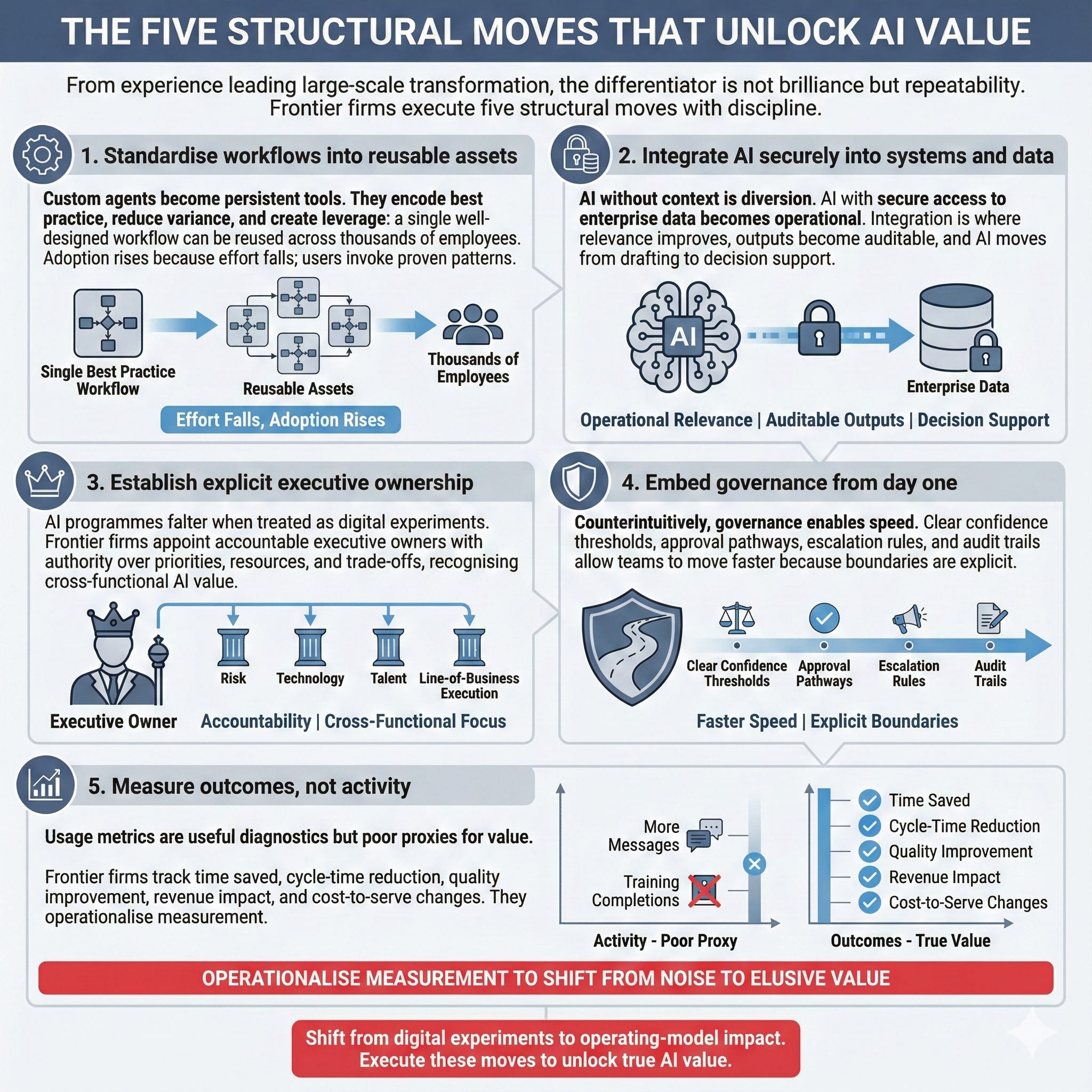
Standardise workflows into reusable assets
Custom agents become persistent tools rather than one-off experiments. They encode best practice, reduce variance, and create leverage: a single well-designed workflow can be reused across thousands of employees. Adoption rises because effort falls; users invoke proven patterns instead of reinventing them.Integrate AI securely into systems and data
AI without context is diversion. AI with secure access to enterprise data becomes operational. Yet many organisations still treat integration as optional, leaving AI as a generic assistant rather than a domain-aware agent. Integration is where relevance improves, outputs become auditable, and AI moves from drafting to decision support.Establish explicit executive ownership
AI programmes falter when treated as digital experiments rather than operating-model shifts. Frontier firms appoint accountable executive owners with authority over priorities, resources, and trade-offs. They recognise that AI value is inherently cross-functional, spanning risk, technology, talent, and line-of-business execution.Embed governance from day one
Counterintuitively, governance enables speed. Clear confidence thresholds, approval pathways, escalation rules, and audit trails allow teams to move faster because boundaries are explicit. The alternative is slower: ambiguity, risk aversion, and reactive policy-making after failure.Measure outcomes, not activity
Usage metrics are useful diagnostics but poor proxies for value. Frontier firms track time saved, cycle-time reduction, quality improvement, revenue impact, and cost-to-serve changes. They operationalise measurement and manage accordingly. Absent this, organisations optimise for noise—more messages, more training completions—while value remains elusive.
A 90-day starting point: readiness in motion
You do not need to redesign the entire enterprise this quarter. You do need to begin building capability methodically. A pragmatic 90-day cycle is sufficient:
Run a readiness diagnostic: Determine where you sit on the maturity spectrum—from individual experimentation to embedded workflows. Be precise and unsentimental.
Select one high-value workflow: Choose a use case with measurable impact within 30–45 days, such as sales proposal turnaround, analyst research synthesis, or customer service triage.
Assign an executive owner and cross-functional team: Governance, data access, and operational integration require clear decision rights.
Standardise what works: Convert the workflow into a reusable template or agent, supported by explicit instructions and guardrails.
Measure outcomes rigorously: Time saved, quality uplift, risk reduction, incremental revenue—select two or three and instrument them properly.
Repeat this cycle quarterly. Capability compounds. Readiness becomes a system. The frontier gap narrows accordingly.
Follow me
That’s all for this week. To keep up with the latest in generative AI and its relevance to your digital transformation programs, follow me on LinkedIn or subscribe to this newsletter.
Disclaimer: The views and opinions expressed in Chronicles of Change and on my social media accounts are my own and do not necessarily reflect the official policy or position of S&P Global.