After a short Summer break (and recovery from a fractured shoulder!), we are back to chronicle the recent advancements in technology and what it means for businesses. In this issue, we take a step back to appreciate what has happened in the space of just a few months and the opportunities these technologies present across various industries. Generative AI has been making waves with its ability to create entirely new and seemingly human-made text and images, attracting millions of users in record time, but as the dust start to settle, concerns are raising too in particular on how to responsibly apply this tech. Let’s dive in.
Focus on: The Rise of Generative AI
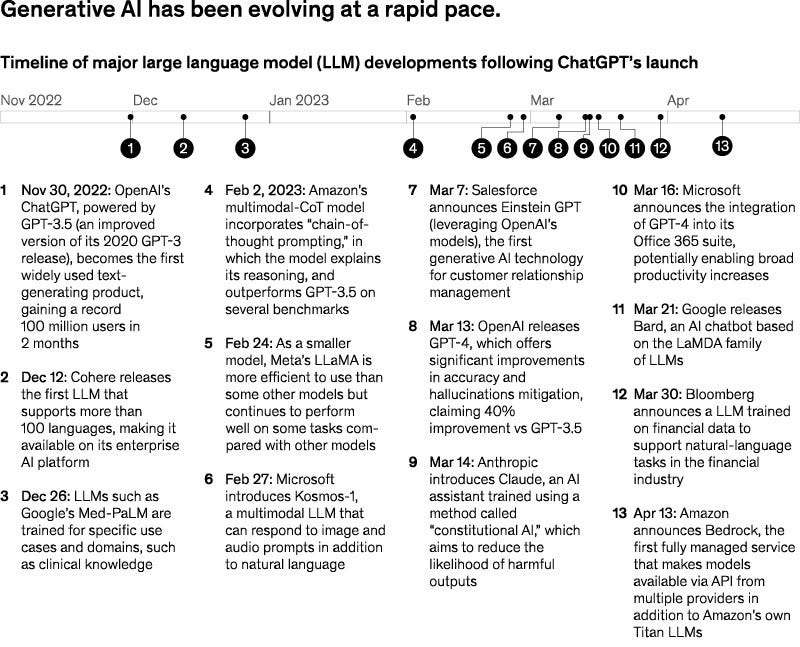
Generative AI models like OpenAI’s ChatGPT and Stability AI’s Stable Diffusion have gained massive traction, with ChatGPT reaching one million users in just five days. These models are already being utilized across industries, with Morgan Stanley testing the technology to help financial advisers leverage insights from research reports. Meanwhile, the government of Iceland has partnered with OpenAI to preserve the endangered Icelandic language, and Salesforce has integrated generative AI into its popular CRM platform. The speed at which companies have scrambled to announce their AI products is staggering, look at this recap from McKinsey:
The Generative AI Value Chain
As generative AI technology evolves rapidly, a new value chain is emerging to support its development and deployment. This value chain consists of six top-level categories: computer hardware, cloud platforms, foundation models, model hubs and machine learning operations (MLOps), applications, and services. While some areas of the value chain may be dominated by tech giants and incumbents, the generative AI application market is expected to expand rapidly, offering significant value-creation opportunities for both established companies and new market entrants.
Generative AI has numerous applications across various modalities, including text, images, audio, and 3D representations. Some examples include drafting interview questions and job descriptions, enhancing internal search tools, generating unique media for marketing and sales, creating educational voiceovers, and optimizing material design in manufacturing. The possibilities are vast, and in the coming issues of this newsletter we will discuss innovative use cases as the technology continues to advance.
Embracing the Future of Generative AI
The rapid evolution of generative AI presents exciting opportunities for businesses and investors alike. As the technology continues to develop and new use cases emerge, it’s crucial for organizations to stay informed and explore the potential benefits of generative AI in their respective industries.
When implementing generative AI technology within existing stacks, it’s crucial to prioritize people and change management. Start by targeting repetitive and mundane tasks that consume valuable human resources, allowing employees to focus on high-value activities requiring human expertise. Be mindful of the ethical sourcing of data and respect copyrighted materials used to train generative AI models. Ensure your organization adheres to these principles to avoid potential legal and ethical issues. When adopting generative AI, it’s wise to start with smaller projects. By doing so, you can closely monitor your workflows, assess risks, costs, and performance, and understand the real value generative AI offers. This allows for informed decision-making as you potentially scale up the technology within your organization.
By embracing these practical takeaways, business leaders and marketing professionals can effectively harness the power of generative AI, driving innovation and growth in their respective industries.
That’s it for this issue of Chronicles of Change. We hope you found this recap of the generative AI space useful as you return to your desks!
Spotlight on: Adobe Firefly
We talked about Firefly back when it was just a web app in private beta. Many Firefly features, such as generative fill and recolor as well as text-to-image and text effects are now widely available on client (beta) apps and on Adobe Express. A great opportunity to play with the future of creative operations!
Follow me
That’s all for this week. To keep up with the latest in generative AI and its relevance to your digital transformation programs, follow me on LinkedIn or subscribe to this newsletter.